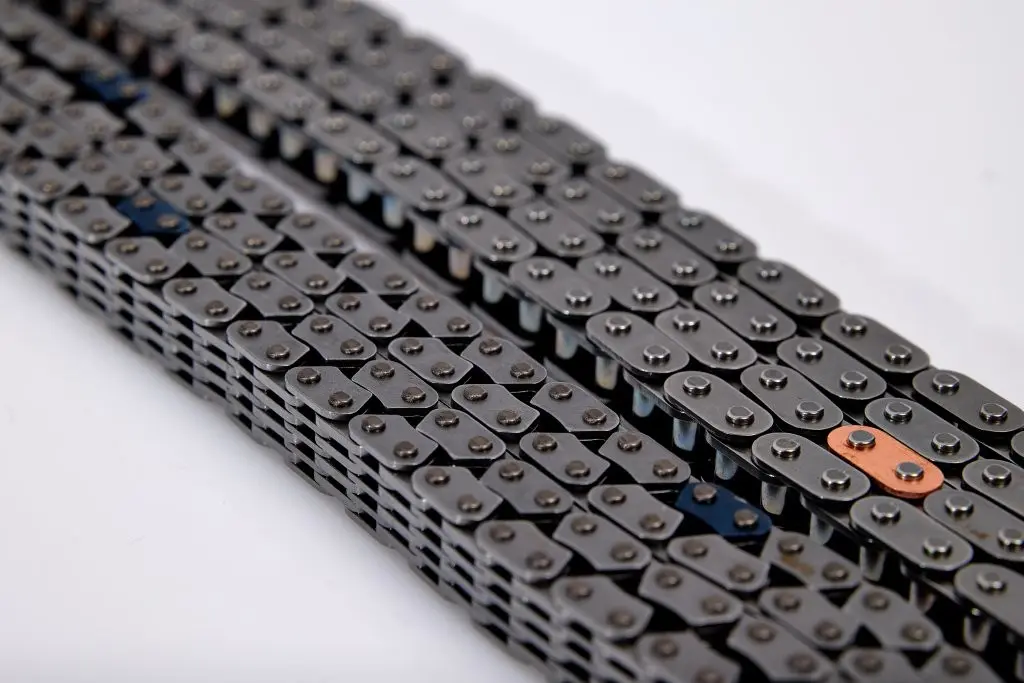
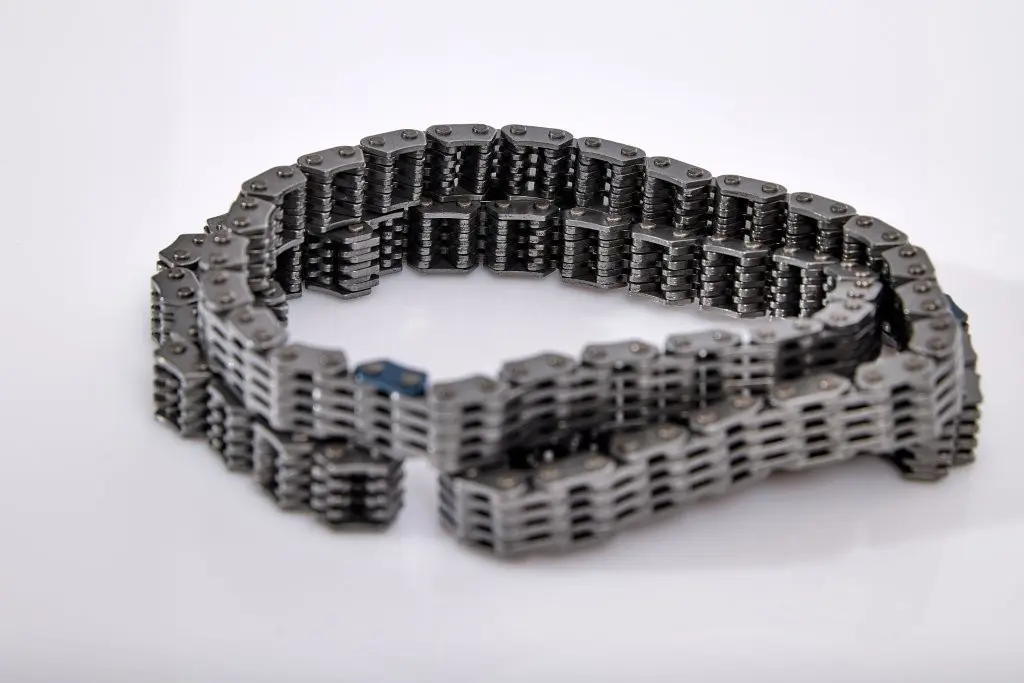
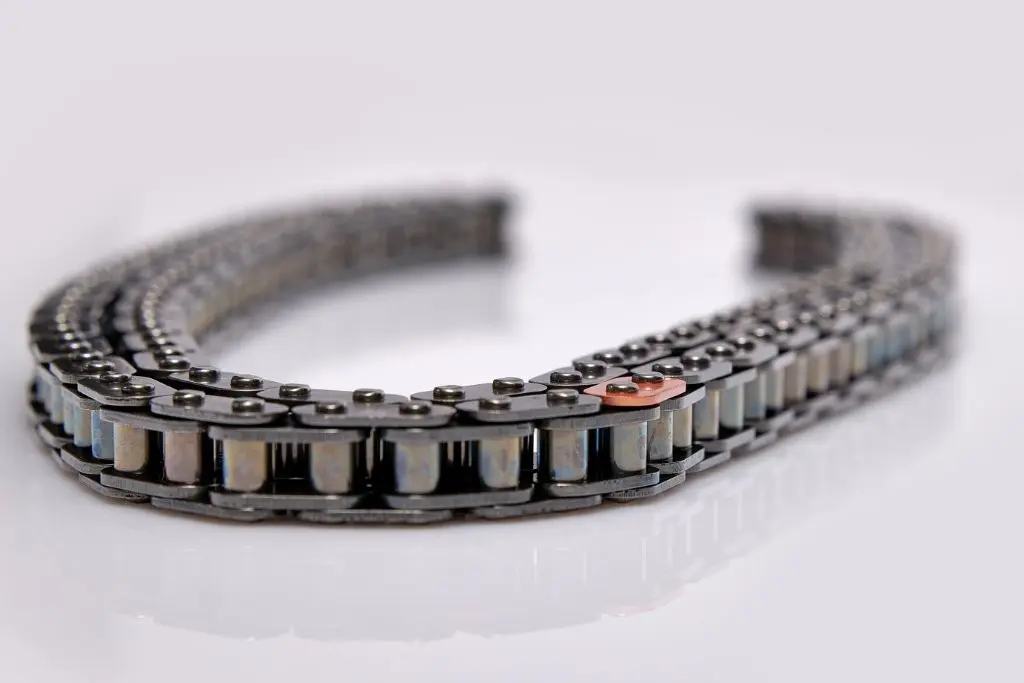
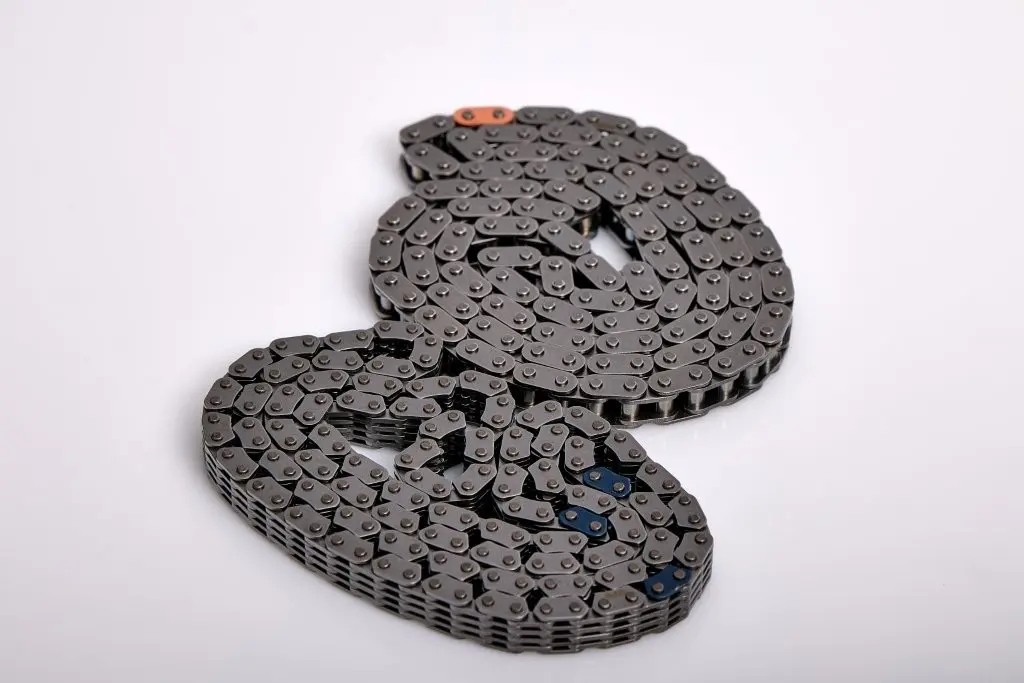
“The chain has stretched” is one of the most common phrases heard when diagnosing a timing drive. Yet the links of a chain do not stretch like rubber.
A chain elongates because its joints wear: the pins and bushings.
In this article, we explain exactly how this process occurs, what accelerates it, how to recognise it and what can be done in the design of the chain itself. We use the vanadium diffusion treatment of pins as an example.
A timing chain is a series of links connected by joints. In each joint, the pin rotates relative to the bushing as the link engages and disengages the sprocket. This movement takes place under load, from the chain tension force. It is repeated with every revolution of the chain, which means millions of times over its service life.
The result is sliding friction between the outer surface of the pin and the inner surface of the bushing. Over time, both surfaces wear and clearance in the joint increases. The distance between the axes of adjacent pins, known as the chain pitch, increases slightly. Wear changes the dimension of a single joint only by hundredths of a millimetre, but a chain consists of several dozen such joints. The wear therefore accumulates along the entire length of the chain.
The following example shows the scale: for a 1,000 mm chain, elongation of 0.269% means an increase in length of approx. 2.7 mm, and elongation of 0.136% means approx. 1.4 mm. The tensioner can compensate for these values, but only up to a point. Every millimetre shifts the relative position of the camshaft and the crankshaft.
The rate of joint wear depends largely on the conditions in which the chain operates. In workshop practice, the same factors come up again and again.
Oil and lubrication system pressure
The chain, guide rails and sprockets are lubricated with engine oil, and the hydraulic tensioner responds to changes in oil pressure. Long change intervals, overrunning long-life intervals and oil that does not meet the manufacturer’s specification all lead to sludge build-up in the oil passages and a drop in oil pressure in the upper part of the engine. The tensioner then responds with a delay. The chain runs in a pulsating manner, alternately slack and taut, and the resulting jerks place sharp loads on the joints.
In direct-injection engines with EGR and DPF/GPF systems, a considerable amount of carbon deposits, known as soot, enters the oil. The soot particles act as an abrasive and circulate in the lubrication system. They accelerate wear of sliding surfaces, including the chain pins and bushings.
Downsizing and turbocharging, now widespread in modern engine design, increase specific loads. At the same time, engines use lighter, thinner chains with a smaller pitch. Low mass matters because engine speed changes so rapidly and dynamically.
On top of this come crankshaft torsional vibrations and frequent cold starts, during which oil pressure builds up slowly. Variable-displacement oil pumps also operate at lower pressures than in older engine designs.
Chain elongation begins in the joint, so the rate of wear depends largely on the surface properties of the pin. These are the hardness, thickness and uniformity of the hardened layer, and how well the layer is bonded to the core material. Timing chain pins undergo thermochemical treatment.
Several methods are used on the market:
| Pin treatment method | What it involves |
|---|---|
| Standard carbonitriding | Enriching the steel surface with carbon and nitrogen, followed by hardening. The most widespread method. |
| Enhanced carbonitriding | A variant of carbonitriding with modified process parameters, producing a denser surface layer structure. |
| Diffusion chromizing (Cr) | Diffusion of chromium into the pin surface, forming a chromium carbide layer on a tempered martensite core. |
| Chromium-vanadium diffusion (Cr-V) | Diffusion of chromium and vanadium into the pin surface. |
| Vanadium diffusion (V) | Diffusion of vanadium into the pin surface, forming a very hard vanadium carbide layer on a tempered martensite core. |
In diffusion methods, the alloying element (chromium or vanadium) penetrates the steel surface and combines with the carbon it contains to form hard carbides. The layer is not applied to the pin; it forms within the pin’s own material. There is therefore no interface where the layer could delaminate or flake off under load, as can happen with a conventional coating.
VANATEC™ is the HEPU® technical standard for timing chains, based on vanadium diffusion treatment of the pins. The vanadium diffusion process itself is neither a new invention nor a patent. VANATEC™ defines the specific parameters a chain must meet and combines them into a single, verifiable standard.

Vanadium carbides can also be produced using powder or gas methods. In the powder method, components are packed in metal powder and heated in a furnace. The process is labour-intensive, and the parts tend to stick together, which makes a uniform layer difficult to achieve. The gas method requires toxic and corrosive gases. A liquid salt bath fully surrounds each pin, so the diffusion layer is uniform across the entire surface. That uniformity is what determines how the joint wears in practice.
Layer parameters
| Parameter | Value |
|---|---|
| Vanadium carbide layer thickness | 0.009–0.012 mm |
| Surface hardness | up to 2,300 HV |
| Core structure | tempered martensite with a small amount of fine vanadium carbides |
Four pin treatment variants were compared under identical conditions in an endurance test running continuously for 800 hours at 5,500 rpm. Under real-world operating conditions, this corresponds to a vehicle mileage of approx. 150,000 km.
| Pin treatment | Chain elongation after 800 h |
|---|---|
| Vanadium diffusion (VANATEC™) | 0.136% |
| Enhanced carbonitriding | 0.181% |
| Diffusion chromizing | 0.198% |
| Standard carbonitriding | 0.269% |
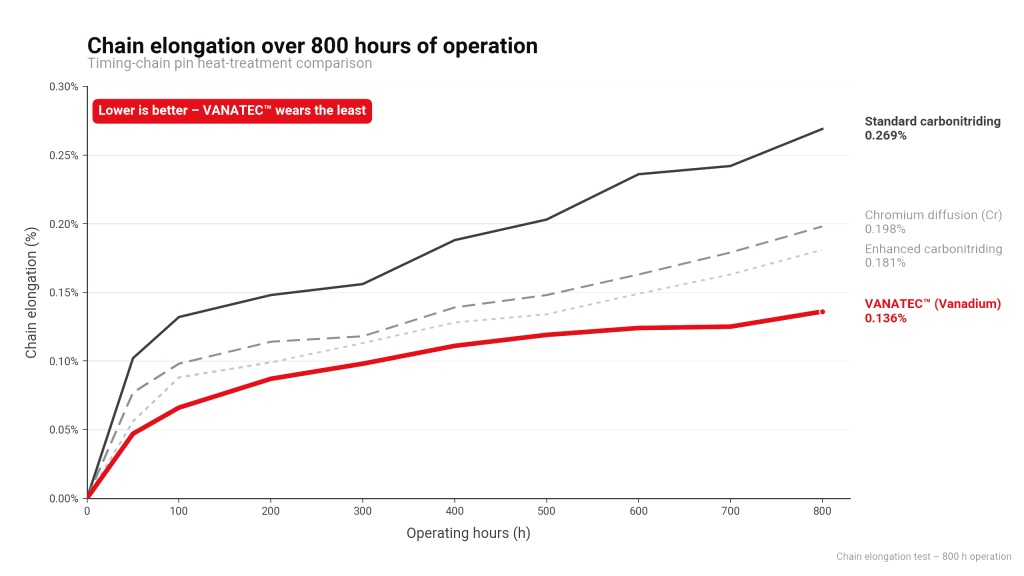
The chain with vanadium-diffused pins elongated approx. 50% less than the chain with standard carbonitrided pins. In this test, that equals approx. 2× higher wear resistance, the best result among the methods tested.
VANATEC™ chains have also undergone hardness testing, metallographic analysis, surface roughness measurement and an installation test in an OEM vehicle.
How to read these results
The test measures chain wear and elongation under comparable, controlled conditions. It does not measure the total service life of a chain in a specific vehicle. Service life also depends on lubrication, oil quality and change intervals, tensioner condition, operating conditions and the condition of the other timing drive components. The correct conclusion is therefore: under the same conditions, a joint with a vanadium-diffused pin wears more slowly. It is not “the chain will last twice as long”.
A VANATEC™ chain is installed in exactly the same way as previous chains. Installation and timing procedures remain unchanged, and the kits are compatible with existing applications.
Pin treatment slows joint wear but does not eliminate the causes described above. Contamination can block the correct operation of the hydraulic tensioner and lower the pressure in the main oil gallery. A chain running under these conditions will still wear faster than it should.
The chain, tensioner, guide rails, sprockets and VVT phasers (where fitted) operate within tightly defined tolerances and wear together.
A new chain running on worn sprockets and guide rails, or with an old tensioner, will not work correctly, however well its pins are hardened.