Price or quality? Or perhaps both in one? Does one exclude the other? These are questions many people ask when facing a vehicle service – especially when replacing the timing system, one of the most critical engine assemblies.
This topic comes up very frequently during meetings with mechanics at technical training sessions and industry trade fairs.
Recently the issue has grown in significance, as drivers increasingly ask about cheaper products – both from mechanics and from customer service staff at parts wholesalers and distributors.
The topic is quite complex, because the (apparent) saving on the day of purchase carries enormous risk of costly failures during subsequent vehicle use. And while at first glance individual components look very similar, the differences lie in the details – often invisible to the naked eye, yet decisive for durability and safety.
This article analyses the quality of spare parts in the context of timing systems – both belt-driven and chain-driven – and explains why saving on the components of this system is one of the riskiest decisions a vehicle owner or workshop can make.
The Most Popular Timing Drive
Belt-driven timing is still the most popular method of transmitting drive to the timing system in automotive engines. Its advantages – quiet operation, no need for lubrication, relatively low production cost – have made it universally used in the vast majority of passenger and light commercial vehicle models.
It is worth noting that in the vast majority of such systems, the timing belt also drives the coolant pump. This is precisely where the differences between high-quality parts and cheap, often unknown-origin products are most clearly visible.
Where, then, does the difference lie? In two critical elements whose quality directly determines durability:
This is particularly important in the case of:
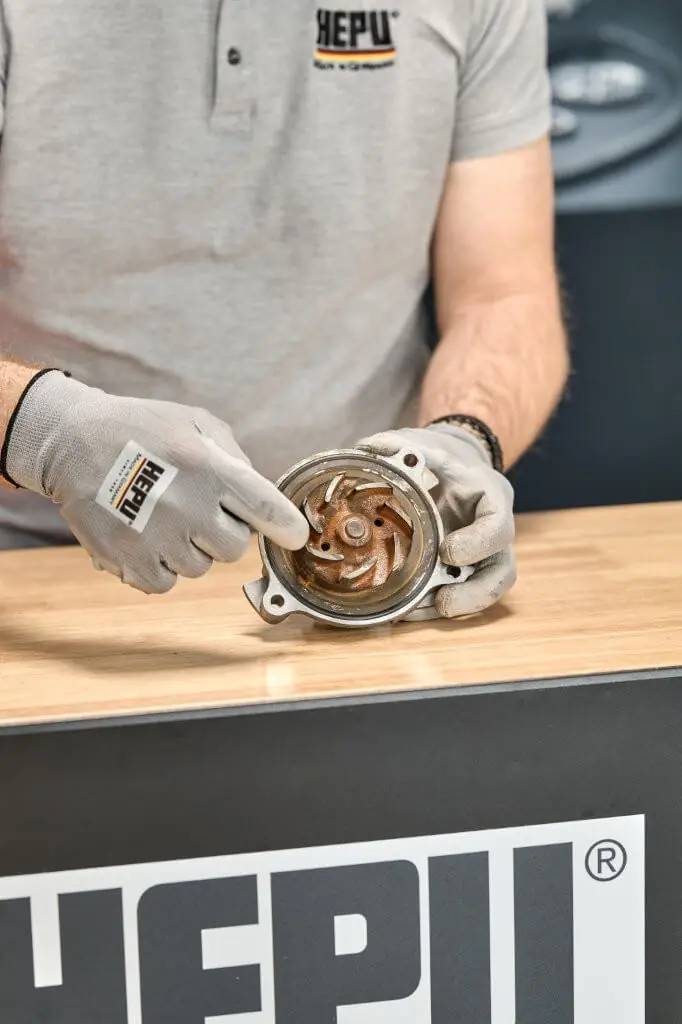
Cheap pumps often use universal seals not optimised for modern coolants – particularly organic-based fluids (OAT, G12+, G13).
The result:
HEPU pumps use seals selected individually to the vehicle manufacturer’s specification – guaranteeing full chemical compatibility with the coolant recommended by the manufacturer.
Comparative example:
|
Parameter |
VW Golf I (1.3) |
VW Golf VII GTI (2.0 TSI) |
|
Engine power |
55 hp |
230 hp |
|
Specific power |
42 hp/litre |
115 hp/litre |
|
Max. RPM |
5,500 rpm |
6,200 rpm |
|
Start-stop system |
None |
Yes |
|
Pump load |
Low |
Very high |
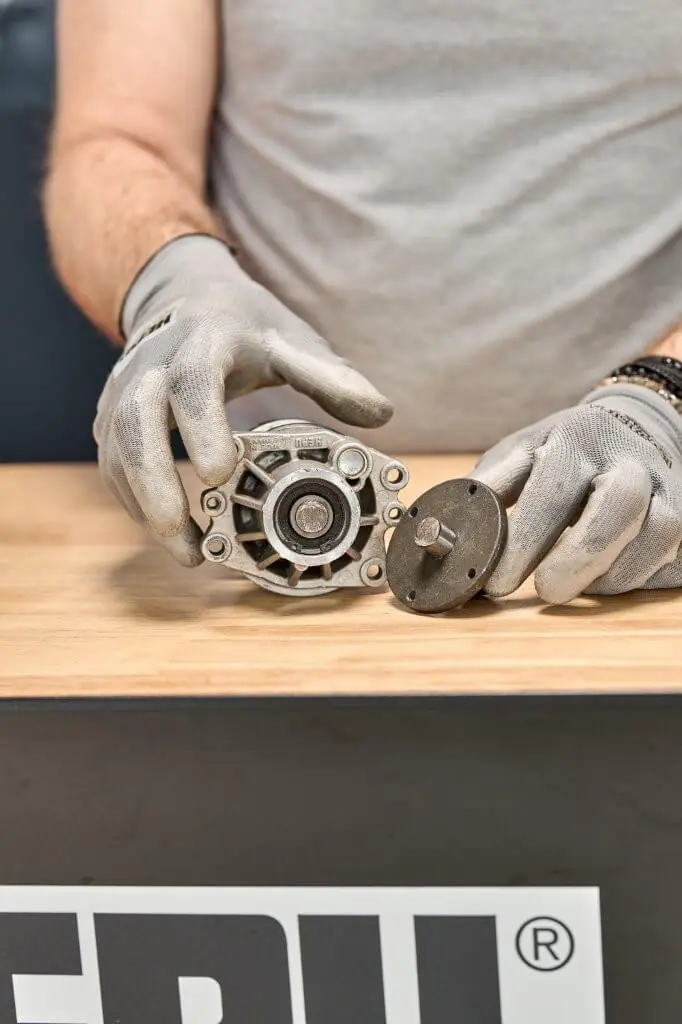
While a ball bearing will survive in a coolant pump for a 1.1 or 1.3 engine fitted in a first-generation VW Golf, it will absolutely not perform in the highly stressed, heavily loaded engine of a seventh-generation Golf GTI:
These conditions will be lethal for pump bearings made from a cheap ball bearing.
HEPU Solution: Needle Bearings for Heavily Loaded Designs
In the case of heavily loaded designs, HEPU uses needle bearings, capable of transmitting significantly greater forces from the drive wheel to the pump shaft.
Advantages of needle bearings:
The remaining components of HEPU timing kits come from verified manufacturers – OEM suppliers to vehicle manufacturers’ original equipment production lines.
The Economics of False Savings: Water Pump
| Scenario | Purchase Cost | Service Life | Failure Risk |
| Cheap pump (unknown brand) | EUR 18–28 | 15,000–30,000 km | 40–60% |
| HEPU pump (OEM quality) | EUR 45–80 | 100,000–150,000 km | 5–10% |
| Failure cost (overheating) | EUR 1,350–2,700 | — | — |
Table 1: Economic analysis – water pump
Saving on purchase: EUR ~35
Potential failure cost: EUR 2,300
Conclusion: A false saving of EUR 35 is not worth the risk of losing EUR 2,300 + damage to workshop reputation + customer stress.
More Difficult to Assess, More Demanding
In the case of chain-driven timing systems, the situation is even more complex than in belt-driven systems. Why? Not only the quality of system components (chain, guides, tensioner) affects durability – equally important are:
With improper chain tensioning, damage to the chain or guides will quickly follow, even if they are of high quality.
Incorrect pressure in the oil gallery, resulting in improper hydraulic tensioner operation, will in the first instance cause noisy timing system operation.
Unfortunately, it is not easy to definitively determine the cause of improper chain drive operation:
Of course, it is most convenient to point to the kit, log ‘chain stretched’ and submit a warranty claim. However, this does not solve the problem – what is needed is a thorough diagnosis of the engine’s technical condition.
The Effect of the Lubrication System on Chain Drive Operation
Key dependency:
Incorrect oil pressure (too low or pulsating) → Incorrect hydraulic tensioner operation → Pulsating chain tension → Pin displacement → Chain ‘stretch’
Remember also that incorrect oil pressure will affect the operation of the variable valve timing system – VVT actuators are in most designs controlled by varying oil pressure.
Chain Quality in the Context of the System
A cheap chain from an unknown manufacturer is characterised by:
Effect:
VVT Actuator Quality: The Hidden Problem in Cheap Kits
Cheap chain kits often do not include variable valve timing actuators, or include low-quality actuators.
Change Intervals: The Absurdity of ‘More Frequent Replacement of Cheap Parts’
During one of the HEPU technical training sessions, discussing parts quality, a mechanic made the following argument:
“I fit cheap brands, but I replace them more often.”
This argument is difficult to defend in the case of timing drive components — replacement every 30,000 km? It simply does not hold up. Why is this argument absurd?