Over the past several years, the cooling system in every new generation of car engines has become increasingly important. In modern vehicles, manufacturers often do not provide for a major repair – engines are designed as “sealed” units, where the failure of a key component means replacement of the entire power unit.
The cooling system has become not only protection against overheating, but a key element of engine thermal management – its efficiency, durability, and compliance with emission standards all depend on it.
Examples of outdated practices:
|
Old school |
Consequence today |
Cost of error |
|
Using tap water |
Limescale deposits within 10,000 km |
€1200–€2500 |
|
“Any pump will fit” |
Incorrect performance |
€1750–€3500 |
|
Filtering old coolant |
Loss of chemical properties |
€1200–€1750 |
|
Installation without system flushing |
Contaminants destroy the new pump |
€650–€1250 |
|
Using silicone “by eye” |
Impeller blockage, leakage |
€1200–€2800 |
That is why we decided to debunk the circulating myths and “old school” rules – and we have compiled the 10 most important principles for servicing water pumps in modern cooling systems.

Problem: “It will fit” – thinking based on experience from the 1990s
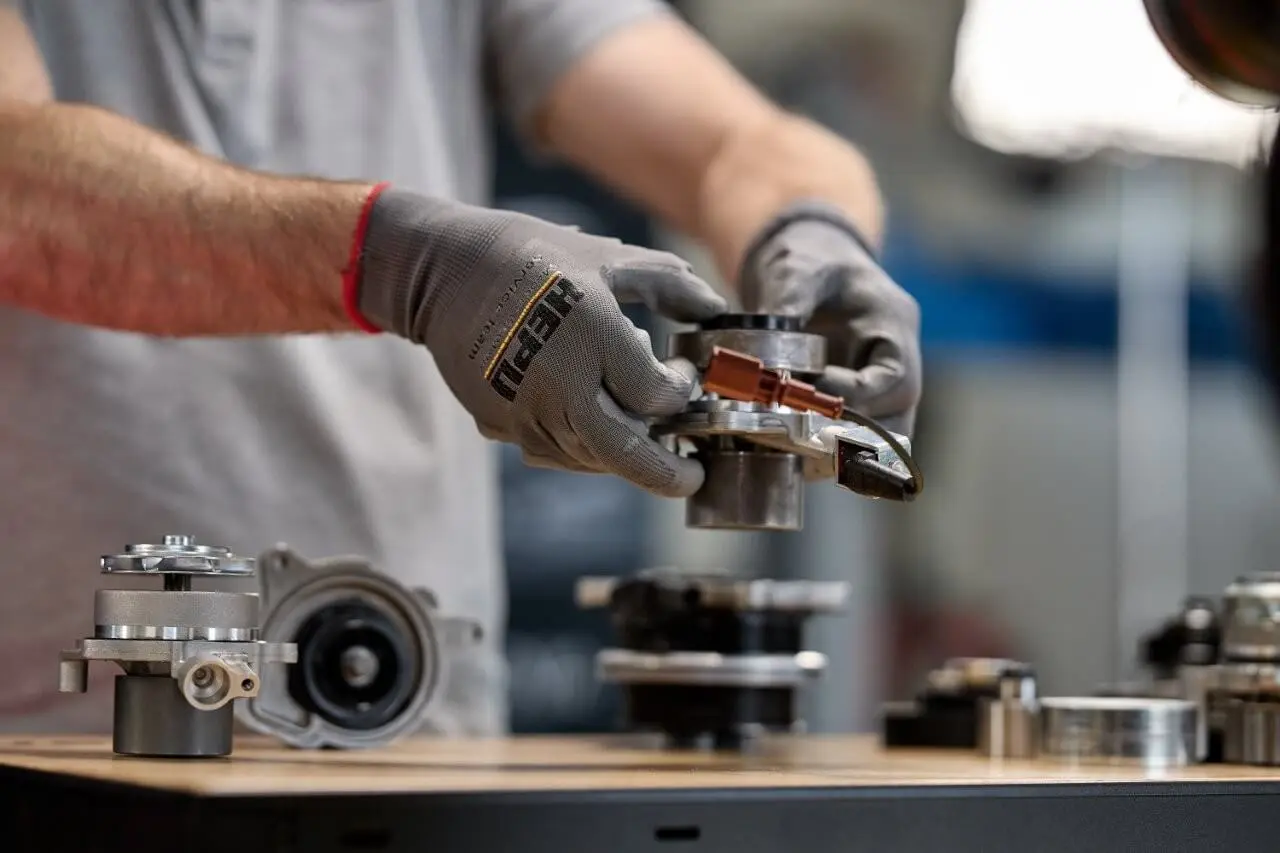
Reality: It may happen that within one engine (depending on the production period), the manufacturer used pumps that differ, for example, in the number of impeller blades – and these matters
Do not be misled by learned patterns and the “it will fit” mindset – always select the pump according to the catalog.
HEPU recommendation: Use the online catalog at www.hepu.de – precise selection based on VIN.
Problem: The mechanic installs a new pump, tightens the bolts, and only then fills the system with coolant.
Reality: Do not start an engine that has not been filled with coolant – you can very quickly damage the mechanical seal (failure within 30-60 seconds).
Cost of error: Destruction of a new pump within 1 minute of operation.
Problem: The mechanic installs a new pump on the surface with remnants of the old gasket, rust, or deposits.
Reality: If the surface is not properly prepared, you will not seal it with silicone – the sealing compound will not adhere to a dirty surface.
Cost of error: Coolant leakage after 1,000–5,000 km → Disassembly and reinstallation.
Problem: “Silicone is the enemy of the cooling system” – a myth circulating in workshops.
Reality: Silicone (as a general term for sealing compounds) is not the enemy of the cooling system, but only if used correctly.
HEPU recommendation: Use high-temperature silicone compounds (resistant up to 300°C) – standard silicone loses its properties at 150°C.
Problem: The mechanic tightens bolts “by feel” or in a random order.
Reality: When installing a pump, always follow the correct bolt tightening sequence and use the specified torque values. This is especially important for fluid management modules made of plastic.
Cost of error: Cracked pump housing (aluminum), cracked module (plastic), loosened bolts → leakage.
Problem: The mechanic drains the old coolant and immediately fills in new fluid.
Reality: Before filling with new coolant, thoroughly flush the system – this protects the new pump from premature failure. Simply draining the old fluid does not ensure proper cleaning – solid contaminants remain in the system and must be removed.
Cost of error: New pump destroyed by old contaminants within 10,000–20,000 km.
HEPU recommendation: Use the online fluid finder at www.hepu.de – precise selection based on specification.
Problem: “We’ll filter the old coolant and it will be as good as new” – a risky saving.
Reality: Filtering old coolant is ineffective and makes no sense – the fluid has already lost its essential properties (corrosion inhibitors, antifreeze performance, lubricating properties).
Customer argument: 6 euro savings = Risk of a 1000 euro repair.
HEPU recommendation: Use the online fluid finder at www.hepu.de – precise selection based on specification.
Problem: The mechanic fills the coolant, runs the engine for 2 minutes, and returns the car to the customer.
Reality: Do not rush – wait until the cooling fans activate (this confirms the full operating cycle of the cooling system).
Waiting time: 10–20 minutes (depending on ambient temperature and engine).
Cost of rushing: Air in the system → Overheating → Failure.
Problem: The customer collects the car after service and does not monitor coolant level.
Reality: Remind the customer to check coolant level every 500–1000 km. Any noticeable drop indicates a leak and requires immediate action.
Problem: The customer believes coolant lasts “forever” (like water or old Petrygo fluids).
Reality: Although coolant is directly related to the water pump, its replacement intervals are completely different. Customers accustomed to older vehicles and practices (like using water or legacy fluids such as Petrygo) may simply not be aware of this.
Invite the customer for coolant replacement after 2 years or 120,000 km (whichever comes first). Explain that after this period, the coolant loses its properties.
HEPU recommendation: Use the online fluid finder at www.hepu.de – precise selection based on specification.